A wall clock is both a practical object and a focal point. Hung at the right height and in the right size, it anchors a wall and is easy to read at a glance. Hung too high, too low or too small, it looks like an afterthought and nobody can tell the time from across the room.
This guide gives you clear heights for every situation, above a sofa, a fireplace, a console, a bed or in a kitchen, explains how to choose the right size of clock for the wall, and walks you through hanging it securely and level. It also covers silent clocks for bedrooms and offices, and how to combine a clock with frames and shelves.
The quick answer: centre at eye level
On a bare wall, hang a clock so that its centre sits at about eye level, roughly 150 to 165 cm from the floor. That is the height at which people naturally look when standing, and the one galleries use to hang pictures.
When the clock hangs above furniture, the reference changes: it should relate to the furniture below rather than to the floor, with a gap of about 20 to 30 cm between the top of the furniture and the bottom of the clock.
Wall clock height by location
| Location | Height | Size guide | Tip |
|---|---|---|---|
| Bare wall, hallway | Centre at 150–165 cm | 30–40 cm | Align with nearby frames or door tops |
| Above a sofa | 20–30 cm above the sofa back | About ⅓ to ½ of the sofa width for a statement clock | Centre it on the sofa, not on the wall |
| Above a fireplace | 15–25 cm above the mantelpiece | 50–80 cm | Leave space for objects on the mantel |
| Above a console or sideboard | 20–30 cm above the top | Narrower than the furniture | Balance with a lamp or a vase |
| Kitchen | Visible from the hob and the table, often above a door | 25–35 cm | Easy-read numbers, away from steam |
| Bedroom | Opposite or beside the bed, centre at 140–160 cm | 20–35 cm | Choose a silent clock |
What size wall clock do you need?
Size is the most common mistake: a clock that looks big in the box often looks small on the wall. Use these guidelines:
- Small, 20 to 30 cm: kitchens, bedrooms, bathrooms, narrow walls, or as part of a gallery wall.
- Medium, 30 to 40 cm: most living rooms and hallways when the clock stands alone.
- Large, 50 cm and over: a statement piece above a sofa, a fireplace or on a large empty wall, especially in rooms with high ceilings.
Above furniture, a statement clock looks balanced at about a third to half of the width of the piece below. Before drilling, cut a circle of paper or cardboard the size of the clock and tape it to the wall: you will see immediately whether it is right.

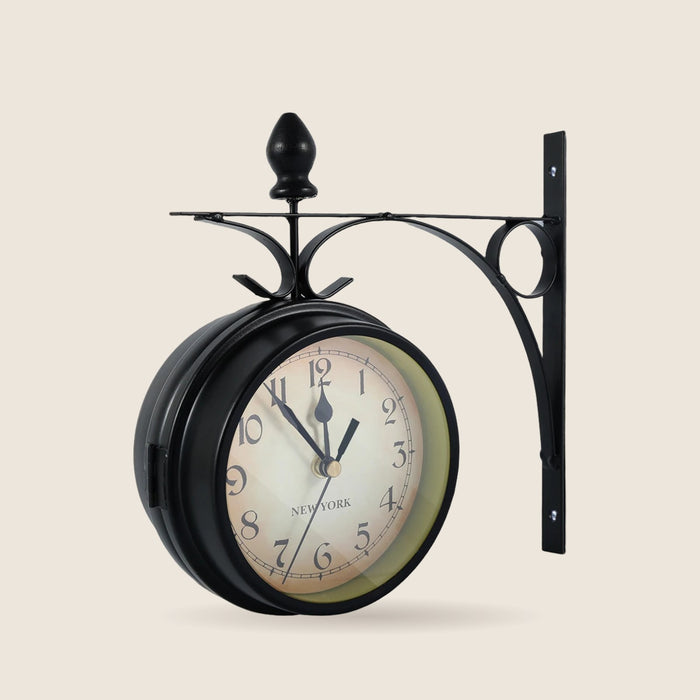
Double-Sided Station Wall Clock
24 × 21 cm · dial Ø 14 cm
82,90 €111 €

Silent Round Analog Wall Clock
Ø approx. 25, 30 or 35 cm
From68,90 €92 €

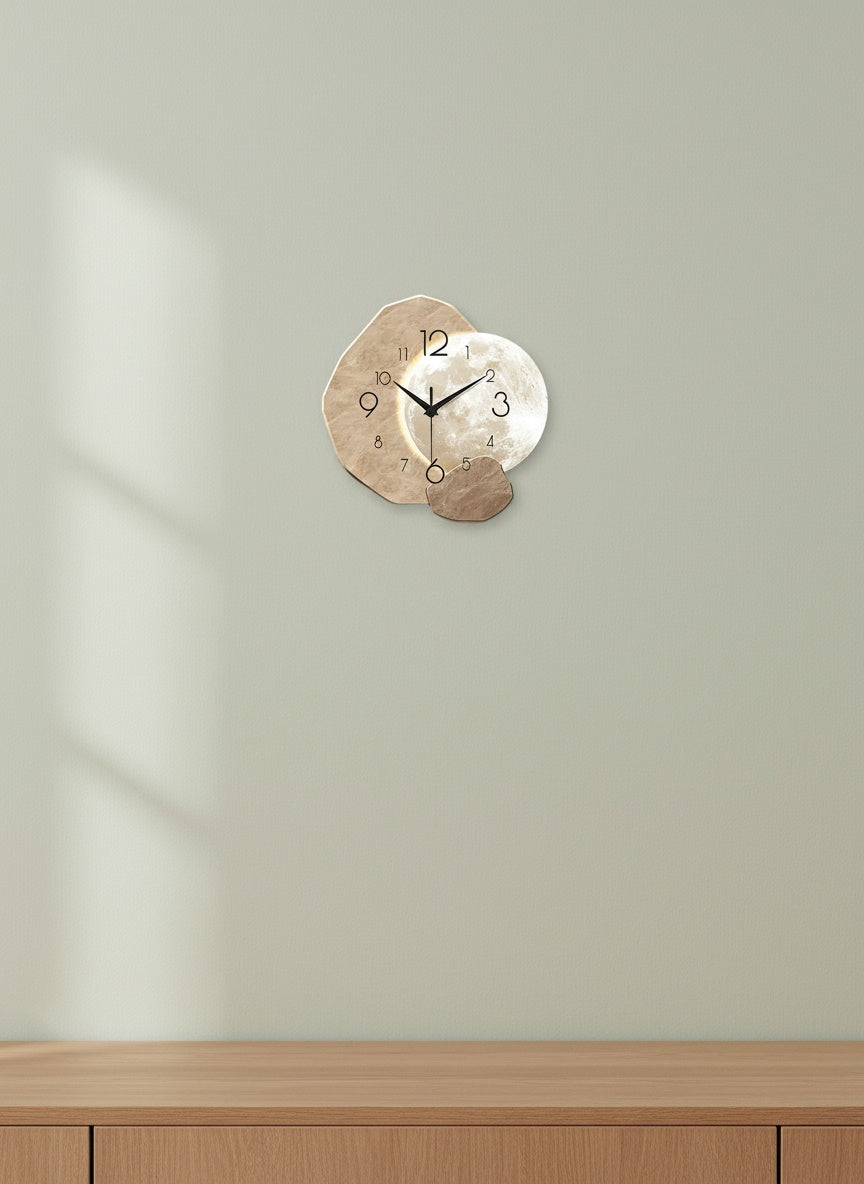
Moon Silent Wooden Wall Clock
Ø approx. 30, 35 or 40 cm
From67,90 €91 €

Wood-Grain Round Wall Clock
Ø 20, 25 or 30 cm
From50,90 €68 €
See our large wall clocks and modern wall clocks.
How to hang a wall clock
- Decide the position with the paper template, then mark where the hanging point on the back of the clock will fall, not the centre of the clock.
- Measure the back of the clock: the distance from the top of the clock to its hook or keyhole slot tells you where to put the screw.
- Check the wall for pipes and cables with a detector.
- Choose the fixing: a picture hook is fine for light clocks on plaster; heavier or larger clocks need a screw and a wall plug suited to the wall, or a cavity fixing on plasterboard.
- Drill and fix, leaving the screw head out by a few millimetres so the clock can hook on.
- Hang and level: place the clock, then check the 12 and the 6 are vertical with a small level or by eye against a door frame.
Silent wall clocks: why they matter
A traditional quartz movement ticks once a second. In a living room it often goes unnoticed, but in a bedroom, a study or a quiet reading corner it quickly becomes irritating. Silent clocks use a sweep movement: the second hand glides continuously instead of jumping, so there is no tick at all.

Botanical Wooden Wall Clock
Ø 25 cm
46,90 €63 €
Browse our silent wall clocks.
Choosing a style for each room
- Living room: a large metal or wooden clock as a focal point, in a finish that echoes the room's other metals or woods.
- Kitchen: clear, easy-read numbers; a retro or farmhouse style suits most kitchens.
- Hallway: a medium clock that you can see on the way out, ideally near the door.
- Bedroom and study: a calm, silent clock in wood or a soft colour.
See our kitchen wall clocks, wooden wall clocks and vintage wall clocks.
Combining a clock with frames and shelves
In a gallery wall, treat the clock as the anchor: place it slightly off-centre and arrange frames around it with consistent gaps of 5 to 8 cm. Next to a shelf, align the bottom of the clock with the top of the objects on the shelf, or centre the clock above the shelf with 20 to 30 cm in between. Our guide on hanging a wall shelf covers shelf heights in detail.
Wall clock ideas, room by room
Living room
Treat the clock as you would a piece of art. A large clock above the sofa or the fireplace becomes the focal point of the room. If the wall already has a television, hang the clock on a different wall so the two do not compete.
Kitchen
The kitchen is where people check the time most, so readability matters more than anywhere else. Choose large, clear numbers and a contrasting face, and hang it where it can be seen from the hob, the worktop and the table.
Hallway and entrance
A clock near the front door helps everyone leave on time. A medium clock above a console or next to a mirror works well; align its centre with the centre of the mirror or the top of nearby frames.
Home office
Place the clock where you can see it without turning your head from the screen, but not directly behind the monitor, which can be distracting on video calls. A silent clock is essential.
Bedroom and nursery
Silent movement is non-negotiable. Hang the clock where you can see it from the bed, at a comfortable height when lying down, generally on the wall opposite the bed rather than above it.
Movements, batteries and care
- Quartz movement: most wall clocks run on a single AA battery, which typically lasts about a year. Silent sweep movements use a little more energy.
- Changing the time: turn the minute hand only, gently, clockwise. Never force the hour hand.
- British Summer Time: clocks go forward one hour on the last Sunday in March and back on the last Sunday in October.
- Cleaning: dust the face and frame with a dry, soft cloth. Avoid sprays on wooden or painted clocks.
- Kitchens and bathrooms: keep clocks away from steam and splashes, which can fog the glass and damage the movement.
Common mistakes
- Hanging too high: clocks near the ceiling are hard to read and look disconnected from the room.
- A clock too small for the wall: use a paper template before drilling.
- Measuring to the centre instead of the hook: always measure where the hanging point is.
- A ticking clock in the bedroom: choose a silent movement.
Frequently asked questions
How high should a wall clock be hung?
On a bare wall, centre it at about eye level, 150 to 165 cm from the floor. Above furniture, leave 20 to 30 cm between the furniture and the clock.
How big should a wall clock be above a sofa?
For a statement clock, about a third to half of the sofa width. A paper template taped to the wall helps you check.
Where should a clock go in a kitchen?
Where it can be seen from the hob and the table, often above a door, away from steam.
What is a silent wall clock?
A clock with a sweep movement: the second hand glides instead of ticking, so it makes no noise. Ideal for bedrooms and studies.